GHK-CuCopper tripeptide
- GHK-Cu — natural copper peptide
- Studied for gene-expression signatures in cell lines
- Studied for cellular repair and tissue regeneration
- Batch-matched certificate of analysis
- Sealed and crimped
- Ships across the EU
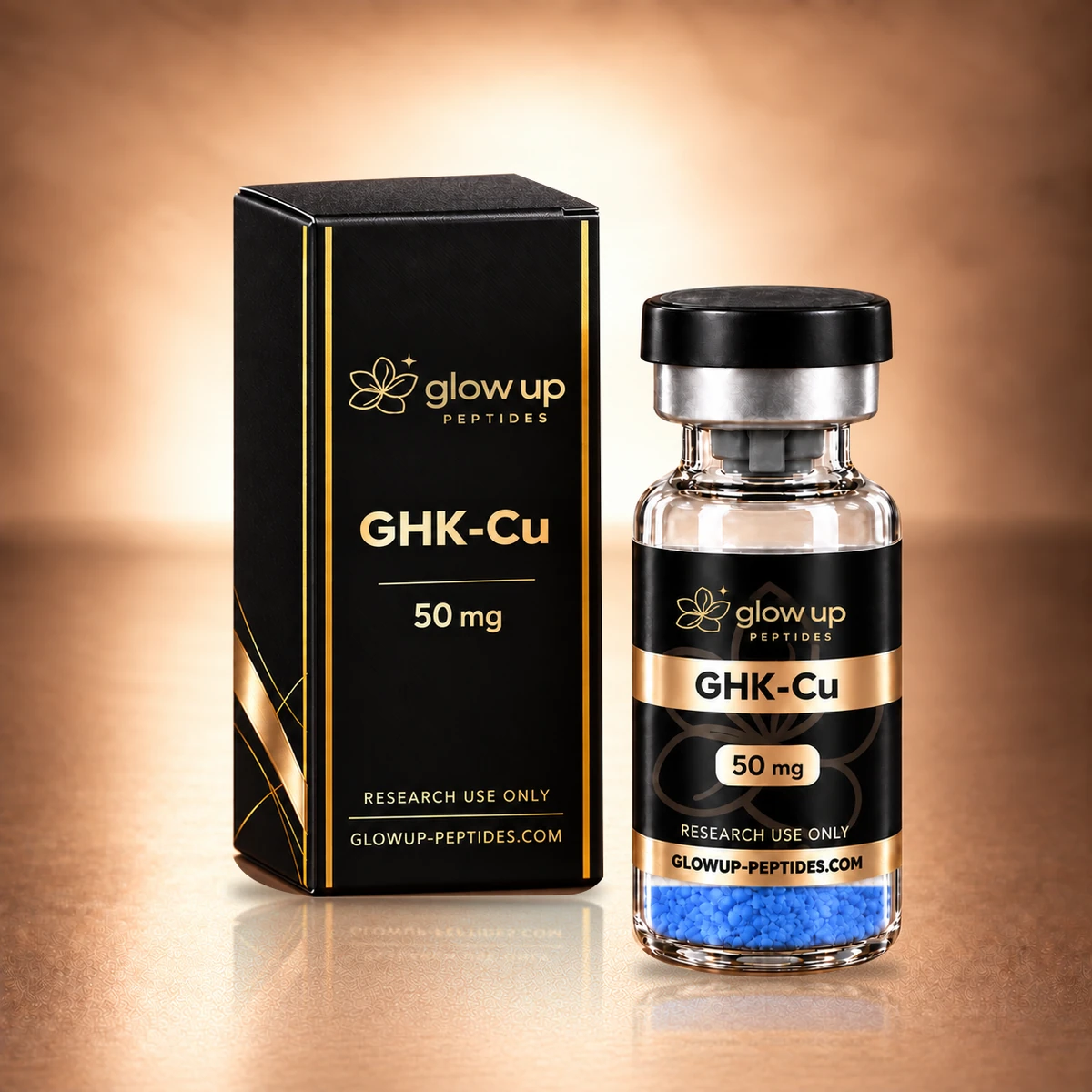
GHK-Cu · 50 mg
COA batchGUP-CU50-20260805
Certificate for the vial sample
- Chemical name
- GHK-Cu
- Purity
- see batch report
- CAS Number
- 89030-95-5
- Molecular formula
- C₁₄H₂₃CuN₆O₄⁺
- Molecular weight
- 402.92 Da
- Mechanism
- Copper tripeptide
- Physical form
- Lyophilized powder
- Net quantity
- 50 mg per vial
- Category
- Peptide lyophilizate
- Storage
- According to label and batch documentation
- Light protection
- Protect from direct light
- Shelf life
- According to label and batch documentation
- SKU
- GUP-CU50
GHK-Cu – Copper Tripeptide
GHK-Cu is the copper complex of the tripeptide glycyl-L-histidyl-L-lysine. Cell-line and computational analyses have examined GHK in relation to gene-expression signatures, extracellular matrix and cellular signalling. These preclinical findings do not by themselves establish a clinical effect in humans. We supply GHK-Cu in lyophilised form for laboratory experiments.
GHK-Cu in Research
Preclinical studies investigate GHK-Cu in the context of skin-cell models, collagen synthesis and regenerative processes at the cellular level, among others. For meaningful in-vitro results, the purity of the tripeptide used is decisive.
Purity, Analysis & Handling
The Lab Reports page shows whether a report is published for a specifically identified GHK-Cu sample or batch; only the methods and measured results stated there are authoritative. Solvent, reconstitution and storage must suit the material, label and validated laboratory protocol. Background is available in the GHK-Cu article; the laboratory calculator performs mathematical concentration and volume calculations only.
All regeneration peptides compared directly: regeneration peptides overview.
The GHK-Cu Pen – Pre-filled Research Format
GHK-Cu, the copper tripeptide, is supplied in the GHK-Cu Pen as a pre-filled research format with a defined concentration. Unlike the vial, it is not intended for reconstitution with bacteriostatic water. The adjustment dial provides repeatable scale values for laboratory workflows; the label and batch-specific documentation remain authoritative.
Laboratory Handling & Dispensing
Before the first laboratory withdrawal, the pen is briefly primed, after which you dial in the desired amount for each laboratory withdrawal. A matching pen needle is always included.
| Amount | Clicks on dial |
|---|---|
| 1 mg | 6 |
| 12.5 mg | 75 (60 + 15) |
| 25 mg | 150 (60 + 60 + 30) |
| 37.5 mg | 225 (60 + 60 + 60 + 45) |
| 50 mg | 300 full pen |
The dial turns to a maximum of 60 clicks per setting — set larger amounts in several steps. For very small amounts (below 1 mg), work out the exact clicks in the pen calculator.
Purity & Quality
A batch-specific analytical report is published for an identified GHK-Cu batch; it does not establish testing of unpublished batches. For detailed background on the compound, see the GHK-Cu article; the laboratory calculator is limited to mathematical concentration and volume conversions.